Showing posts with label Ehlers Danlos Syndrome. Show all posts

Tuesday, 19 May 2020

How local authorities are breaching the Care Act and getting away with it

I am a 45-year-old "younger" adult in receipt of social care.  To be honest I don't feel that "young" at 45 but social workers use common words and phrases in a completely different way to everyone else.  In case you were wondering "younger adult" refers to anyone over 18 and under 65.

For over 20 years I have been struggling to live some kind of a normal life despite my health problems and physical limitations.  I'm sad to say that I have found that more often than not social care is incapable of care.  There are some wonderful, caring people working in social care but the system has been decimated by austerity and decades of chronic underfunding so local authorities can't provide the help and support needed by "younger" and older adults alike.

I am chronically ill and physically disabled.  I have a connective tissue disorder called Ehlers Danlos Syndrome, and I also suffer from autonomic dysfunction, histamine intolerance, Sjogren's Syndrome, chronic pain, chronic fatigue and chronic inflammation. There is no cure and no treatment.  I try to manage my symptoms with painkillers, pacing, physio and diet.  Every day brings new challenges but I put on a brave face and try and live life to the fullest.

I am a part-time wheelchair user and I need support with all daily activities that most people take for granted, such as having a bath, cooking a meal and going to the shops.  I'm lucky to have some support from my husband and family but they have their own lives and responsibilities, and their own health problems to deal with.  In order to maintain good relationships with them, I don't want to have to rely on them for everything.  I don't want to be a burden.  I want to be a wife and mother.  I want to be able to do things for myself, even if that means needing help from another person to do it.  Unfortunately, from my experiences with social care that is too much to ask for.

I've been on Direct Payments (also known as Personal Budgets) since 1998 and I've seen a lot of changes over the years.  The Care Act 2014 was the biggest change of all as it provided national guidance when previously each local authority had their own policies.

The Care Act 2014 is law and is explained in plain(ish) English in The Care and Support Statutory Guidance.  The document is about as long as the complete works of Shakespeare and it reads both as a comedy and a tragedy.  It's not supposed to be but as a "younger adult" with a dark sense of humour, I can only laugh at the optimistic statements about achieving outcomes and cry about how my local authority ignores every single word of it.

The Care and Support Statutory Guidance states:
1.1 The core purpose of adult care and support is to help people to achieve the outcomes that matter to them in their life.  
Cue the first laugh from me.  My experience has been the exact opposite.  I've had five social care reviews since the Care Act came into force.  Not once have I been asked about my outcomes or what matters in my life.  In preparation for my most recent social care review in October 2019 I wrote down seven outcomes that I would like to achieve.  I gave the social workers a copy, I even emailed them a copy in case they lost the paper one.  They completely ignored my outcomes and when I complained they denied that I had ever mentioned them.

My local authority is failing to meet the core purpose of social care.  And that's just the beginning.

I've been locked in battle with my local authority for the last 18 months.  Here's a little background to set the scene.

In May 2017 I had an annual review.  This happens about once every 18 months.  Social care has always been oversubscribed and underfunded so in my local authority annual often means 18 months.  The review meeting took place at home and it lasted about an hour.  I was asked about my needs and as nothing had changed my Personal Budget remained the same at 24 hours per week.

The breakdown of support included
  • 15 hours per week Personal Assistant support for personal care, meal preparation and parenting my three children, 
  • 3 hours per week for domestic tasks, including cleaning, laundry and food shopping, 
  • 6 hours a week to access the community, which basically means getting out of the house and doing all the normal things that people do like meeting a friend for coffee, going to the library or attending appointments.   
I was happy with this level of support.  It met my needs, it allowed me to live my life the way I wanted to.  It also gave me the flexibility to deal with emergencies like picking up a poorly child from school or when the hospital clinic running two hours late.

Since my PA of eight years retired in 2016 I have struggled to find and retain staff to work the hours I needed.  No-one wants to work the tea-time shift and half the people who apply for the job are only doing it to keep their unemployment benefits.  Eventually, I got lucky.  At the beginning of October 2018 I was employing two PAs and life was good.  Then I got a phone call from my local authority and my world got turned upside down.

A Community Care Officer phoned to make an appointment for my annual review.  It had been 17 months since my last one.  Nothing had changed since my last review and according to the Care and Support Statutory Guidance, my support should have stayed the same.  It says in section 13.33 
Periodic reviews and reviews in general must not be used to arbitrarily reduce a care and support package. Such behaviour would be unlawful under the Act as the personal budget must always be an amount appropriate to meet the person’s needs. Any reduction to a personal budget should be the result of a change in need or circumstance.
So no change in need and no change in circumstances means no change in budget, right?  WRONG!

The assessment got off to a rocky start.  The community care officer couldn't get her laptop working so she had to use pen and paper instead.  I told her everything was pretty much the same as last time but she said she had to do the review as a brand new assessment.  I didn't know it at the time but this was actually a breach of The Care Act.  The guidance says reviews must be proportionate and a ‘re-assessment’ cannot occur without the local authority first conducting a review and then deciding that a revision of a plan is necessary.

The review was very stressful and tiring. I had to describe every minute detail of my day, justifying why I need help to have a bath, why I need help to get dressed, describing how I use the toilet and other personal questions.  It lasted over 90 minutes.  It would have been longer but I had to stop because I was exhausted and I had a migraine.  As the community care officer packed up her things she said she would be recommending that my support remain the same.  I was relieved it was all over for another year, or maybe 18 months.  I took my pain killers and had a nap.

A couple of weeks later I got a phone call from an OT offering me an assessment.  It was a surprise as no-one had mentioned an OT referral.  I'd had two OT assessments in the last three years and I already had all the equipment I needed (apart from a stairlift which I couldn't afford and I wasn't eligible for a grant for) so I kindly turned the offer down.  There's a long waiting list for OT assessments and I didn't want to waste their time.  The OT phoned back an hour later saying her manager said I had to have the assessment to "prove" I needed the personal care support that the community care officer wrote in her assessment.  I had no choice but to agree.

I won't go into detail about the OT assessment because it is very triggering for me.  Let's just say the OT was sanctimonious, argumentative and disagreed with everything I said on principle.  She promised it would be a brief visit yet she dragged it out for nearly 90 minutes.  She demanded I justify what the community care officer had written in the assessment.  I didn't know what to say because I hadn't even seen a copy of it yet.  The OT bullied, mocked and belittled me until I broke down.  She left me sobbing as she closed the front door behind her.  Her parting words were spoken in a slow, patronising manner.  She would be writing everything down and she would recommend my support remain the same.  The last part was a total lie.

I was still upset when my PA arrived an hour later.  She said I shouldn't have thrown the OT out on her ear for treating me the way she did.  I complained about the OT's behaviour but she denied everything.  As her manager had not witnessed her behaviour nothing could be proven, so nothing was done.

A couple of weeks after that I received a phone call from the Notts Enabling Service.  I had no idea who they were and I was reluctant to give out any personal information over the phone.  They asked me what I'd like to be able to do.  I wasn't sure what to say.  There are lots of things I'd like to be able to do but my health problems get in the way.  If I push myself too hard my symptoms get worse and it can take days or even weeks to recover.

I asked them what exactly do they do? The lady was quite vague but she did give two examples.  She said they taught a young man with a learning difficulty to choose what clothes to wear and they also taught a woman in a wheelchair how to cook. She sounded a little patronising.  I'm too independent for my own good (sometimes to my own detriment) and I didn't think it would be helpful to me so I politely declined the offer.

I already know how to do everything I want to do, I just can't physically do it due to the nature of my disability. My joints are hypermobile and unstable, I struggle with severe pain and fatigue, I can't stand without feeling dizzy and faint, my grip is poor and my muscles go into spasm.  My symptoms change from hour to hour and every day is different.  One day I may be able to do a task for an hour, the next day I may be bedbound and effectively useless. Even if they could teach me how to do a task there is no guarantee I would be able to do it reliably or independently on a regular basis.  I would still need support.

An OT once told me I need to learn how to pace better and delegate more.  This is where a good PA is worth their weight in gold.  They allow me to do things I'm not physically capable of without risking my health.  I can be involved in tasks and in control but when I need help or I need to stop the PA can support me or take over and finish the job.  They can also help me monitor my health.  When I'm busy doing something I often don't notice the warning signs that I've done too much but with training my PA can tell me to correct my posture when I am rolling my ankle or encourage me to take a break when I go pale or start to shake.

A few days later the NES me a brochure in the post.  It said the service was for people with autism, learning difficulties and younger adults with physical disabilities.  I didn't think it applied to me because I was 43 at the time and hardly "young", but as I mentioned at the start of my story, social care uses words in a different way to most people.  "Younger adults" means under 65.  I'm sure the service would be helpful to some people but I just found it a bit patronising and yet another way of reducing support.

https://www.nottinghamshire.gov.uk/care/adult-social-care/help-living-at-home/enabling

Twelve weeks after my annual review I received an email from the community care officer.  After both reviews I was told my support would stay the same so I was shocked to learn my support was being reduced from 24 hours to 16.5 hours per week.

I was not happy!  I complained.  The local authority told me it is their policy to promote independence and they cannot continue funding packages of care when they are questioning the amount.  I had no idea why they were questioning it.  My support hadn't changed in the past four years and neither had my needs.  It was only much later after I complained to the Local Government Ombudsman that I discovered the truth.

The local authority had already decided to cut my budget before they even reviewed me.

Every year the adult care finance team audit my Direct Payments.  I send them copies of my bank statements and invoices to prove I have been using my budget correctly.  If I have too much surplus money in my account they ask me to pay it back.  In 2018  returned a large sum of surplus funds, just over £6,000.  The local authority assumed that this had been accrued over the previous 12 months.  They told the Local Government Ombudsman that this showed I was not using all of my support hours.

This was incorrect.

During 2016 and 2017 I had to recruit new staff.  Recruiting can be quite costly so following my annual audits in 2016 and 2017 I asked the adult care finance team if I could keep my surplus funds to cover these costs.  They agreed.  By the summer of 2018 I didn't need the surplus funds any longer so I paid them back.  I returned three years of surplus funds accrued when I was unable to recruit staff or find agency cover, minus what I'd spent on recruitment support.  Three years, NOT twelve months.  I gave the LGO copies of bank statements which proved the local authority had made a serious error, but by this time it was too late.  The local authority had already implemented the reduction in support.

My physical and mental health suffered as a direct result of their error.

Anyway, back to my complaint response.  The local authority said there was an expectation for my husband and teenage children to perform all the household tasks, meal preparation and assist me to access the community.  My husband works full time, he's out of the house for 10 hours a day, 5 days a week and both him and our children suffer from physical and mental health problems.  I gave all this information to the community care officer during my assessment but they ignored it.  I spoke (and disagreed) with the OT about it too.  I said my husband can't do everything (meaning working full time, doing all the household tasks, caring for me, caring for the children, being a parent, having a life and looking after himself).  She bluntly told me she was a single parent and she had to do everything.  As a social care professional, I hoped she'd appreciate the differences between our situations, but she didn't.

I still had no idea why the local authority cut my budget by 7 hours a week.  I asked to see a copy of the assessment.  I still hadn't seen it, so I didn't know what had been written about me or if it was even correct.  I was told if I wasn't happy with the decision they would do another assessment.  My heart sank.  I'd already endured over 3 hours of interrogation which had caused physical pain and mental anguish so I declined and I asked again to see a copy of the assessment.  They compromised by sending me a self-assessment form that I could complete at my leisure.  I asked a third time for a copy of the assessment and they finally agreed to send it to me.

When I read the assessment it seemed very familiar.  That's because it was almost word for word the same as my previous assessment.  The community care officer had cut and pasted everything from the last assessment and added the odd sentence for clarity.  Everything else was the same, except for one section - "Differences of Opinion".

I could tell this section had been written by the OT because it contained all the things we had disagreed about.  It included several things that were not true and mentioned several things that we hadn't even spoken about.  The local authority used this biased and incorrect information as evidence to reduce my care.

My hours were now broken up into the following allocations:
  • 1 hour per day (5 days a week) for personal care
  • 30 minutes (5 days a week) for lunch prep
  • 30 minutes (5 days a week) for evening meal prep (but my husband is expected to help with this or I could use my own money to pay for the local "Meals at Home" service - more about that later!)
  • 30 minutes domestic support per week to clean the kitchen and bathroom
  • 6 hours per week to access the community, including going to my medical appointments, taking my children to their medical appointments, doing food shopping.
There were many problems with this.  There was no support for parenting, there was not enough support for evening meal prep or making packed lunches and there was no allowance for flexibility.  If one task took longer than the allotted time I would be unable to meet my other needs.  I would have to choose between having a bath or going to a hospital appointment, buying food or making lunch.  It also made it impossible for my staff to meet my needs.  They had been doing two visits a day, but with this reduced support plan they would have to do three or four visits a day.  My staff were not prepared to do that as they would spend as much time travelling to work (unpaid) as they would working.  The support plan also relied on my husband and children making up the 7.5 hour shortfall in support, which they were not physically able to do.

I complained and explained why this plan would not meet my needs.  The local authority told me it would.  They gave me no other reason for the reduction.  This breached the Care Act.

The local authority also indicated that I had agreed to the assessment.  That was impossible as this box was checked before I'd even seen it.  I'm pretty sure that's not legal.

The 30 minutes a week for domestic support was a joke.  Both the community care officer and the OT mentioned it was "policy" to only allocate 30 minutes of domestic support per week if the service user lived with someone else.   The local authority said the Care Act states they only need to keep people's homes "safe and clean".  They interpret that as cleaning the kitchen and the bathroom once a week, which they reckon can be done in 30 minutes.  They said if I wanted more cleaning done I could use my benefits to arrange that privately.  They also said they had no such policy but they would not allocate more than 30 minutes per week.  So it is policy, just not a legal one.

Eventually, the local authority did concede that my husband's health problems made it difficult for him to do all the household tasks on his own, so they increased my support by 30 minutes per week.  My budget was now 17 hours per week.

I still couldn't believe it.  Nothing had changed and they cut my support by 7 hours per week.  They didn't listen to my complaints,  they ignored evidence which contradicted what the assessment said,  they just kept saying it would meet my needs.  They refused to discuss the matter any further and signposted me to the Local Government Ombudsman if I was unhappy with their decision.

I complained to the LGO.  I explained how the local authority had breached the Care Act in numerous ways, how the reduction in support was not sufficient to meet my needs and how my health was suffering as a direct result of the reduction.  It was a complete waste of time and I wish I'd not bothered.

It took the LGO seven months to reach a decision.  They found the council were not at fault.

The problem with the LGO complaints process is that they can only investigate if the local authority has failed to follow the correct procedure.
We cannot question whether a council’s decision is right or wrong simply because the complainant disagrees with it. We must consider whether there was fault in the way the decision was reached. (Local Government Act 1974, section 34(3), as amended) 
So if the local authority makes a decision without reviewing you, or they say you can't have a review when you're entitled to one then the LGO can say something about that.  If the local authority did everything right but made a completely insane decision then the LGO are not allowed to question that decision.

In my case, the local authority had followed the correct procedure. They had given me an assessment, they offered me another assessment when I was not happy, they offered my children young carers assessments (even though they don't care for me) and they offered my husband a carers assessment.  The local authority breached the care act and their decision making ignored all the evidence I provided but in the eyes of the LGO they were not at fault.  They did nothing wrong.

This is a massive flaw in the complaints system.  The local authority could have assessed me and decided my needs could be met by riding a unicorn to take tea with the fairy queen, and the LGO would not be able to question he decision because the local authority had followed the correct procedure.  It really is that ridiculous.

Even if the local authority had done something wrong the LGO has no power to make them do anything about it.  They can only advise what action should be taken.  The local authority is under no obligation to do it.  So basically local authorities can get away with metaphorical murder and no-one can stop them, unless you have the time, money and energy to take them to court.

A statement from the LGO's final decision said:
The Council confirmed to me that, where there is a disagreement with clients about a reduction in care package, the Council will carry out a review after three to six weeks to assess how the reduced package is working. 
As my support had been reduced seven months earlier the local authority had failed to do this.

One week after the LGO decision I received a phone call from a social worker.  She said they wanted to do an independent review.  I asked how it would be independent.  They said it would be conducted by a social worker who worked for my local authority but it would be someone I hadn't met before.  That isn't exactly independent but I had to agree with it.

I prepared for my review meeting by writing up seven outcomes I wanted to achieve.
·         To be able to manage my health conditions and pain
·         To be able to prepare fresh healthy food to follow my low histamine diet
·         To be able to support my husband and take care of my children’s needs
·         To be able to visit country parks to walk my assistance dog
·         To be able to go to a craft group
·         To be able to volunteer for Hug in a Blanket, make crochet squares and assemble blankets for sick and disabled children
·         To train as a volunteer speaker for Canine Partners to educate, raise awareness and fundraise for the charity who provided me with my assistance dog.
I wrote how the reduction in support wasn't working and how it was adversely affecting my physical and mental health and my relationship with my family.  I also wrote another page with all my medical diagnoses and symptoms, describing how they affect me and limit my ability to be independent.  I thought it would be helpful but I'm not sure why I bothered because everything I wrote was completely ignored.

I asked if we could keep the assessment brief, 45 minutes or less.  It lasted for an hour.  I went through all the highly personal questions again, justifying why I need help and why I can't do some things by myself.

The enabling service was mentioned again.  "So you don't want to be more independent?" the social worker said in a disapproving tone.  I found that insulting and upsetting.

I have done so much to maintain my independence, from buying a second-hand powerchair, and buying a smart plug so my Amazon Echo can turn my reading lamp on, to getting my assistance dog who can do at least 30 different tasks for me, including fetching another person or bringing me the telephone in an emergency.

The differences of opinion reared their ugly head again too.  The social workers made it absolutely clear there was an "expectation" for my husband and children to do all the household tasks, such as cleaning, laundry and shopping.  My husband was present for the assessment and he said he often doesn't sit down until late in the evening because he's busy looking after me and doing things around the house.  I tried to explain how my children's health problems prevented them from performing the expected tasks but they insisted that there was an expectation for them to be involved and if they have "needs" I can refer them to children's services.  They also offered them young carers assessments again.  I can't understand the point because they are not young carers.  They don't care for me and I don't want them to care for me.

Three weeks after the review one of the social workers emailed me to ask for more information about my children.  They wanted letters from their health professionals and more information about how their conditions affect them.  I thought this was odd because in the assessment they said they could not consider their needs, but I was hoping they would consider them.  Despite me spending hours collating hospital letters and writing up all their symptoms and problems everything was ignored.

I was also asked to give consent for the local authority to contact my health professionals.  I wasn't sure how to word it so they sent me a draft letter which gave them blanket consent for them to contact absolutely anyone about me.  I wasn't sure how safe that would be so I wrote my own letter giving them consent to contact my GP.

Twelve weeks after my 2019 review I received a copy of my assessment and support plan.  The local authority had decided my needs could be met with 17 hours of support per week.

Nothing had changed.  All the evidence that proved 17 hours was not enough had been completely ignored.

There were numerous errors in both the assessment and support plan.  I was asked to sign a letter to state that I agreed with the assessment.  I wrote a three-page response detailing all the errors and stating how I did NOT agree with it.

One of the issues was regarding meal preparation.  I have a medical condition called histamine intolerance.  It was diagnosed by an NHS consultant and it causes chronic inflammation and allergy type symptoms.  I was advised by my consultant to follow a low histamine diet.  It's a very complicated diet.  Many foods are excluded, including hidden ingredients such as preservatives and thickening agents, and everything must be absolutely fresh.  My consultant told me to avoid processed, pre-prepared and reheated foods.  All of this information was recorded in my assessment but the local authority decided that if I wanted to be "flexible" with my budget I could use the Meals at Home service.  They produce bland, school dinner type meals for frail pensioners who can no longer cook for themselves.  I looked at their menu and it was not appetising, plus over 90% of the foods were not suitable for me.

https://www.nottinghamshire.gov.uk/media/1743025/countyenterprisefoodsbrochure.pdf

I told the social worker about this.  She said the food was suitable because they can cater for allergies.  This is coming from someone who repeatedly called it an "anti-histamine diet" rather than a low-histamine diet.  I explained why Meals at Home food was not appropriate but they insisted that it was, so I called their bluff.  I emailed County Enterprise Foods and sent them a copy of the food compatibility list that my consultant had given me.  They replied two weeks later saying they would not be able to meet my dietary requirements.

I informed the local authority and forwarded a copy of the email from County Enterprise Foods.  Their response said what I had told the Meals at Home service was "too rigid" and they believed that my diet was based on my own personal research.  I corrected them and provided evidence in the form of diagnosis letter from my consultant.

A few weeks later I received an updated copy of the assessment and support plan.  They had changed two things but many errors remained.  I dumbed down my response to them so there would be no misunderstandings.  I annotated a copy of the documents indicating exactly what was wrong and why.

Another issue with the assessment was about my volunteering.  One of the core wellbeing areas mentioned in the Care Act is access to work, education or volunteering.  I wanted to volunteer to assemble blankets for sick and disabled children but I would need help to do this.  The local authority said my husband could help me or I could use my community access hours to do this.  If I did that I wouldn't have time to leave the house.  That didn't seem right because the volunteering would be done at home, not out in the community.

I explained my husband was not able to help me.  I needed to do certain tasks in the daytime, work to a deadline and post the blanket by Royal Mail as soon as it was completed (funding for which was provided by the charitable group).  They responded and said my husband can help me in the evenings and weekends and I could use another delivery service.  This was just not possible.  Even if my husband had the time and energy to help me I would still need to complete some tasks in the daytime when he is at work to meet the deadline.

I asked why this outcome hadn't been recorded in the work, education and volunteering section of the assessment.  They said that category does not generate a budget, they signpost people to services and refer them to the enabling service.  I've become quite efficient at searching the Care and Statutory Guidance and I found an interesting statement.

6.106 h)  Accessing and engaging in work, training, education or volunteering - local authorities should consider whether the adult has an opportunity to apply themselves and contribute to society through work, training, education or volunteering, subject to their own wishes in this regard. This includes the physical access to any facility and support with the participation in the relevant activity.
This contradicted what the council had told me.  I wasn't surprised though.  Both the OT and social worker had admitted they didn't know what was in the Care Act.

I received a final response from the complaints department.  They stated that my assessment had been reviewed by five people and they were satisfied that it was accurate and that the level of support is sufficient.  They also said they cannot investigate a decision just because I don't agree with it.  They refused to respond any further.

The local authority has done so many things wrong that I have lost all faith in them.  I could write a book about all the other things they did wrong but it wouldn't make any difference.  I still haven't agreed to my assessment because I still haven't got a correct copy, but the support plan has been implemented regardless.  I don't know why they even bother reviewing me as it doesn't seem to make any difference.

The impact this has had on my physical and mental health has been devastating.  I've suffered severe stress and anxiety and I've spent hours crying about it.  I've lost count of the hours I spent reading, researching and writing letters but I have been powerless to change anything.

I feel like I'm worthless, I don't deserve any help, I don't deserve to live a full and independent life.  It's too much to ask for.  I am nothing and nobody.  I dread my next review because I don't know what they will cut next.

I don't know what I've done wrong.  It's not fair how they've treated me but the only option left is to take legal action and I don't have the time, energy or money to do that.

The worst thing about my situation is I'm not the only one.  My issues seem trivial compared to the other stories I have read.  Disabled people are being treated worse than animals, being forced to wet the bed because it's not essential to have support to go to the toilet when your needs can be met in other ways, such as sleeping on an incontinence pad even though you have continence issues.  Young adults are being forced into residential care because it's cheaper than supporting them to stay in their own home.

Local authorities are wilfully ignoring the Care Act and are barely meeting people's basic needs.  They don't have sufficient funding to consider people's wellbeing, outcomes or how they would like to live their lives.
Could you imagine being told you don't need to go to the shops because you can do an online order once a week?   
Could you imagine being told you don't need to cook fresh food because you could heat up a ready meal in the microwave? 
Could you imagine being told you don't need to go to the pub to see your friends because you could phone them instead? 
The whole care system urgently needs an overhaul and more than anything it needs proper funding.

My final thoughts return to the opening statement of the Care and Support Statutory Guidance.
1.1 The core purpose of adult care and support is to help people to achieve the outcomes that matter to them in their life.
My local authority has failed to do that.  They have denied me the opportunity to achieve my outcomes and support my husband and my children.  They have failed to implement a person-centred approach by insisting that pre-existing services, such as Meals at Home and the enablement service will meet my needs, without even considering what matters to me.  They have done the bare minimum they can get away with and assumed my family will support me without asking if they are willing and able.

I will be washed, dressed, fed and allowed out of the house for 6 hours a week.  I will be kept alive but it's no kind of life.  And no matter how hard I fight, there is nothing I can do about it.

The local authority won't respond to my complaints anymore.  I have been signposted to the LGO but I've already experienced how pointless that is.  The local authority has made it very clear.  Just because I do not agree with their decision does not make it incorrect.  Proof that they have breached the Care Act means nothing.  After all, five people from the same local authority department have reviewed my assessment and they can't all be wrong, can they?

Thank you for reading my story.


Thursday, 11 February 2016

Schrodinger's Cripple

Sometimes I have a hard time getting my head around my illness and disability.  I've been disabled by Ehlers Danlos Syndrome for so many years that living with the constant pain, fatigue and numerous other symptoms has become normal for me.  It's only when I have to take a long hard look at my quality of life in terms of a Social Services care assessment or a disability benefits application that I realise how very disabled I am.  It's quite depressing admitting your weaknesses but it's made me realise that what people see is can be a very different picture to who I really am.

If I post a picture of my dinner on Instagram and say, "I made this, it's so yummy!" you might assume that I am capable of cooking a meal by myself.  What you don't see is the PA who took me shopping for ingredients because I can't drive or get my mobility scooter out of a car on my own.  You don't see how I had to brace my knee and walk with a crutches so I can move around my kitchen, or how much pain and fatigue that caused me.  You don't see my PA peeling vegetables or lifting heavy pans off the hob because I can't do it.  You don't see me resting on my stool because the heat from the hob has made me go so dizzy I feel like I'm going to pass out.  You don't see me pushing myself past my limits through the pain and fatigue or the muscle spasms in my hand as I chop and stir.  You also don't see after taking that picture I feel too exhausted to eat the meal I just claimed to have made.

In my head I believe that I made the meal because I planned it and I oversaw the cooking of it but in reality if I had to make it from scratch on my own I wouldn't get past the first step.  Did I just make that meal?  Yes, but not really.  It's not as simple as yes or no.

Herein lies the problem.

Physically disabled people today have to be Schrödinger's cripple - there is an expectation for you to be an awe inspiring role model, a paralympic  athlete or successful entrepreneur bravely defying your physical limitations, but at the same time to get any kind of help from the government in terms of disability benefits or social care you have to be a invalided cripple who can't wash, dress or even convey food to your mouth, otherwise you get no help at all.  Very few people can be both but just because you can do some things doesn't mean you don't need support in doing others.

I currently claim DLA, Disability Living Allowance but some time in the near future I will be migrated to PIP, which has a different eligibility criteria.  The amount of money I receive each week could drastically change, I could get nothing at all or I could get almost £60 a week more.  I have no idea which, that is entirely up to the decision makers.  This is a great cause for concern for me because I rely on that money to provide the medical care, equipment and support that is not available to me on the NHS.

I looked up the eligibility criteria for PIP.  It's all done on a points system and it's very black and white. My condition changes on an hourly basis so I find it impossible to say if I can perform certain tasks such as taking a shower or walking a certain distance because they are dependant on many variables and fluctuations of my numerous medical conditions.  If I can do something one day there is no guarantee I can do it the following day, or even the following week.

To get the enhanced rate of the mobility component of PIP you must be able to walk less than 20 metres. How far can you walk?  This might seem a simple enough question to answer but for me it quite complex.  You might see me walk 20 metres on crutches from my PA's car into the GP surgery and think yes, she can walk 20 metres, but that is not the whole story.

You don't see how much pain and fatigue that caused me, you don't see how I had to make a maximum dose of pain killers and muscle relaxants when I got home because I pushed myself beyond my limits to walk that distance.  You don't see the damage I did to my unstable shoulders by using the crutches or the pain I will suffer for the next week because of it.  You don't see how I had to order pizza that night because I was too fatigued to even make a sandwich for dinner.  You don't see how I felt too ill to do anything the following day because I overexerted myself from desperately trying to be normal and independent and walking instead of  using a wheelchair or mobility scooter.

If the decision makers decide I can walk that 20 metres I wouldn't score enough points to get the Enhanced rate of PIP mobility component.  In real terms that means losing £1,853.80 a year in benefits (or nearly £3,000 a year if they decide I can walk more than 200 metres) plus no longer being eligible for a Motability vehicle.  That is a massive loss if you're struggling to survive on benefits or rely on the Motability scheme to be able to run a suitable car and retain your independence.

Iain Duncan Smith wants disabled people to find jobs and work their way out of poverty.  He doesn't seem to appreciate that not everyone is capable of working, even with reasonable adjustments.  You might presume I can work because I wrote this blog post but it has taken me several days of short sessions at the computer to compose this.  If I were writing professionally I would be expected to produce this every single day, but even if I worked from home there is no way I could do that 5 days a week to an acceptable standard.

The government believe that working can help people with chronic illnesses but for people like me the physical stress and effort would make my condition deteriorate to the point where I would be bed bound and have very little quality of life.  I struggle with just looking after myself, never mind working enough hours to earn a living wage.  Leaving the house just to go to the shop on my mobility scooter can leave me so fatigued I can't do anything for a few hours and there are days when I'm not capable of doing anything at all - and that's when I'm well!  If I get a virus or an infection which can happen up to 6 times a year, then I could be bed bound for up to a month.  Just getting out of bed in a morning is work, never mind having a shower, getting dressed or doing a few basic household tasks.

This leaves me and thousands of other disabled people in a very difficult position.  On the surface we appear too well to need financial or practical support but we are too sick and disabled to function without support.

What we need is understanding and support so we can manage our conditions and live a happy and productive life.

What we don't need is constant scrutiny, sanctions and the withdrawal of benefits and support services by people who have no understanding of what it's like to live with a long term illness or disability.  We don't think we're entitled, we don't want to be benefits scroungers but with the right kind of help and support some of us might just surprise you and actually become that awe inspiring Schrödinger's cripple.

Friday, 7 August 2015

I've got a wobbly knee cap!

Knee pain has been a big problem for me since I was a teenager but it's not something anyone ever investigated properly.

When I was fourteen years old I suffered a severe chest and sinus infection that caused a high fever and suspected brain swelling.  A few weeks later I became ill again, telling my mum that my knees hurt and I couldn't go to school because I had the flu.

When I was fifteen I was diagnosed with Myalgic Encephalomyelitis because no-one knew what was causing my malaise, joint pain and fatigue.

When I was eighteen I was admitted to hospital with severe pain in my joints, including my knees.  The doctors didn't know what was wrong as my blood tests came back normal.  They suggested my problems were psychosomatic because ME was fashionable at the time.  My GP wanted me to see a rheumatologist so my parents took me to see a private doctor.  I suffered a particularly painful examination and the doctor declared there was absolutely nothing wrong with my joints.  He admitted to knowing nothing about ME but suspected it was psychological and was he was insistent that I should stop using a wheelchair and get more exercise.

The pain never went away.  I started using a walking stick as I was unstable walking and I was referred for physio but that made my body weaker and my pain worse.  By the age of 20 I had to use a wheelchair outdoors as I could no longer walk any distance without severe pain and fatigue.

I continued to have problems with my knees and six years ago after a bout of strep throat I had a massive flare of pain which was diagnosed as post streptococcal reactive arthritis.  The pain persisted in my right knee and a local GP sent me for an x-ray but it came back as 'normal'.  The pain was blamed on 'wear and tear' and I was told it was something I'd have to live with.

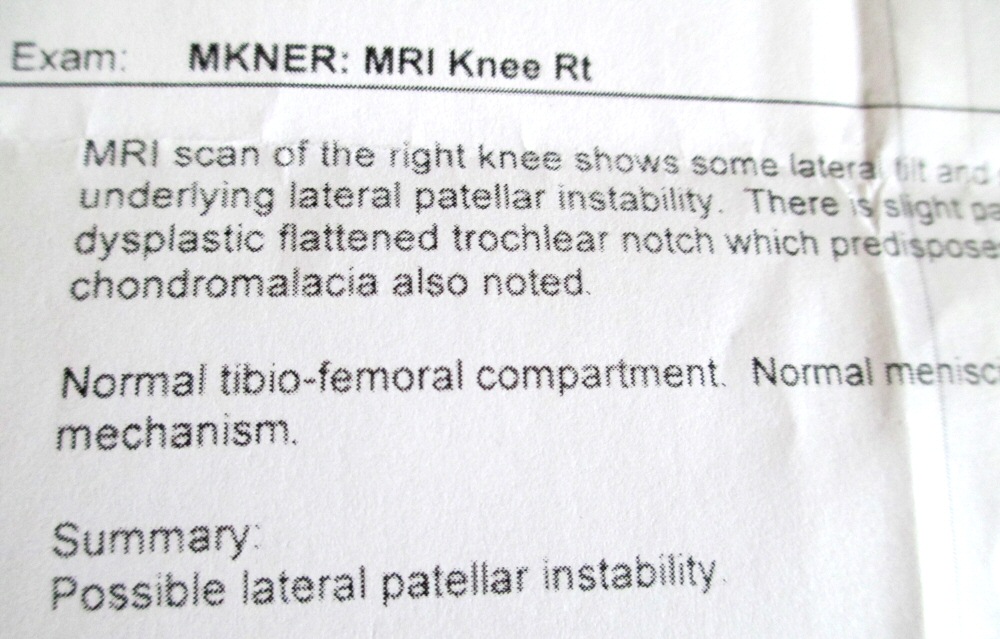
Everything changed when I was finally diagnosed with Ehlers Danlos Syndrome.  Suddenly my complaints were taken seriously rather than being dismissed out of hand.  A few weeks ago I mentioned my knee pain to my GP.  I had been suffering swelling and tenderness under my right knee and a tender lump behind it.  She sent me for an MRI scan to investigate the problem.

When I phoned the surgery for the test results I was given a vague message, 'Consistent with Ehlers Danlos syndrome.  No further damage'.  I was a bit disappointed.  It didn't really tell me anything and I thought my problems were going to get swept under the carpet and ignored once again.  I made an appointment to speak to my GP about the results and what I found out I have a wobbly knee cap!

After 25 years of problems I finally knew what was wrong.  My patella showed lateral tilt and subluxation which could be due to patellar instability.  I had a slight patella alta, dysplastic flattened trochlear notch and early patellar chondromalacia.

In English that means my knee cap is at a funny angle, it's too high, there is no grove to keep it in place when I bend my knee so it partially dislocates, and the back of my knee cap is worn down more than it should be.

This fits with my diagnosis of Ehlers Danlos Syndrome and explains why I have found it so difficult to walk and exercise.  I don't have a fear of moving or hypersensitivity to pain, I actually have a physical problem.  It's news I didn't want to hear but it is reassuring after so many years of disbelief.

The next big question is what can I do about it?  I have been referred to an orthopaedic surgeon to discuss my options.  In otherwise healthy people they would do surgery to correct the problem but EDS complicates things and could potentially make things worse.  It looks like I have some hard decisions to make but I'm hoping I will be given a few options regarding my potential treatment.  I am frustrated that it has taken this long to find out what is going on but at least now I have a way to move forward.

Tuesday, 31 March 2015

An open letter to David Cameron

In the lead up to the general election I've been thinking about who I should vote for.  The leaked Conservative party benefit options got me very worried because it could mean financial hardship for my family simply because I am too ill to work.

I understand the need to make budget cuts but penalising the chronically ill and the disabled is unfair and a false economy.  I got quite angry about it so to vent my frustrations I decided to write an open letter to David Cameron.

-----------------------------------------------------------------

Dear David Cameron

I wonder if I could ask you a question.  Why should I vote for you?
 
My name is Clair Coult, I am married with three children, my husband works full time but I am unable to work due to being chronically ill and disabled.  I suffer with a rare and incurable genetic condition called Ehlers Danlos Syndrome - Hypermobility Type, I also have a condition called Postural Orthostatic Tachycardia Syndrome and an autoimmune condition called Sjogren's Syndrome.  Every day I suffer with severe joint pain, fatigue, tachycardia and a whole host of debilitating symptoms.  I am virtually unable to walk but with the right medical, social and financial support I can manage my symptoms, have a better quality of  life and I can contribute to our society in my own small way.

The problem is it is very difficult to get the support I need.  The NHS has repeatedly failed me.  I was misdiagnosed and mistreated for 24 years.  I had to research my own health problems and pay privately to get the correct diagnosis.  I have also struggled to get any support in managing my condition on the NHS. 

In 2013 I was discharged from A&E in severe pain and considerable distress.  I was told to discuss my problems with my consultant.  The waiting time to see my consultant was 22 weeks.  I could not get an earlier appointment.  I paid to see a private consultant and I was seen within 11 days.  It cost £300 and I was given treatment that managed my severe pain. 

My consultant said I need extensive physio but NHS policy means I can only get 6 weeks treatment on one body part, then I have to wait another 8 weeks to be referred again.  This is crazy! 

When my consultant writes to my GP it can takes weeks, sometimes months before the letter is processed and anything is done about it.  This causes an unnecessary delay in my treatment and prolongs my suffering.  This is not acceptable.

My GP is under pressure to reduce referral costs so she is reluctant to refer me to people who can help me manage my conditions and give me a better quality of life.  This means I either go without support or I have to pay privately for consultations and treatment.  This is not acceptable.

I have to pay for my own prescriptions, annual sight tests (essential due to the risks of my medication) and dental treatments.  I purchase a pre-payment prescription certificate but it costs me £104 a year and I still have to pay for my necessary vitamins, supplements, compression stockings and treatments.  My dental treatment costs are high due to the damage that Sjogren's syndrome does to my mouth.  Dental bills often cost several hundred pounds per year.
 
I also have to pay for disability aids and equipment.  I have an NHS manual wheelchair but I cannot push it myself so I have had to pay £600 for a mobility scooter and £500 for a second hand electric wheelchair for the privilege of moving around independently.  I also have NHS crutches but by using them I risk damaging my unstable joints so I have had to pay £90 for a more suitable pair of crutches. 

I have been assessed as needing a stair lift but because my husband is in full time employment we would have to pay £9,000 for one.  I was loaned a bath lift by Occupational Therapy, essential for my safety when bathing, but it did not meet my needs.  The most suitable bath lift would cost me £600.  We cannot afford to pay for either a stair lift or a bath lift without getting into debt of nearly £10,000.  I could use my DLA lower rate care money but it would take me over 8 years to save up.  This is not acceptable.

I need support to manage my personal, social and domestic care needs but cuts to the local authority budget mean they cannot afford to meet my eligible needs as outlined in Fair Access To Care Services.  My revised care plan was very limited and basically treated me like a prisoner.  I was only allowed to leave the house for 2 hours a week, I could only do supermarket shopping on the internet, not at the local shops or market, and I was only allowed three hours support a week with all domestic chores (cleaning, shopping and laundry) for a family of five.  They expected my husband to work full time, commute 50 minutes each way to work, do all the household chores, laundry and shopping, and also be a full time carer for me and our three children.  That is an impossible task for one person. 

I have been lied to and bullied by social workers and last year it took seven months of fighting with my local authority for me to retain my care package.  I had to seek the help of my MP, research policy documents and put in a Freedom Of Information request regarding a policy that was quoted by several social workers but the policy never actually existed.  The assessments were not about supporting me to live independently and meeting my eligible needs, they were about reducing my care package and cutting costs as much as possible.  The stress and effort involved caused my health problems to significantly deteriorate.  This is not acceptable.

I claim Employment Support Allowance and due to the severity of my disabilities I have been placed in the Support Group, but I am concerned that in the future I will be unable to claim because my husband works full time.  Due to the high costs involved in managing my disabilities the loss of ESA would leave my family in financial difficulty.  This is not acceptable.

I currently claim DLA but I am also concerned about being migrated to PIP as the assessment does not take into consideration the complex and variable nature of my health problems.  I have already had to give up my Motability car because I didn't know if I would qualify for PIP and we couldn't afford to be without a suitable vehicle.  Ehlers Danlos Syndrome is a variable and often misunderstood condition.  Sometimes I can just about walk 20 metres, sometimes I can't even stand up.  How far I can walk cannot be answered by a tick box because every hour of every day is different. 

Ehlers Danlos Syndrome is also rare and I have to travel 150 miles to London to see my consultants as local doctors do not have the experience or knowledge to help me.  This can cost up to £200 in train tickets alone, plus my husband has to take unpaid leave from work to take me as I am unable to travel on my own.  If you take away my mobility support I will be unable to attend the essential medical appointments that help me manage my conditions.  This is not acceptable. 

I understand that in this economy cuts have to be made but cutting NHS, social care and disability benefits is false economy.  You are punishing the people who cannot help themselves, through no fault of their own. 

If you deny me access to adequate medical and social care my health will deteriorate to the point where I will need 24 hour nursing care.  This will cost the government significantly more than supporting me to live independently with my family.

I am not alone in this situation.  There are thousands of chronically ill and disabled people like me struggling for help and support, and I think I can speak for them when I say our lives are challenging enough as it is without having to fight for the support we need to do the things you take for granted.

So considering my situation, could you please tell me why should I vote for you? 

Are you going to do anything to support chronically ill and disabled people like me? 

Yours sincerely

Clair Coult


Wednesday, 11 February 2015

Looking after number one

From past experience physiotherapists are not my best friend. Their well meaning advice has unfortunately lead to more pain and suffering rather than better health and recovery, so I'm always a little nervous when I get referred to see someone new.

Today I met a wonderful physio, who for the first time in my life recognised what could be causing my pain. My muscles don't relax after being contracted. They stay tight long after the exercise or movement has been completed, despite me being in a physical and mental state of relaxation. This explains a lot!

My EDS consultant, Dr Cohen, thought it may be beneficial to have trigger point therapy on my neck as I suffer with very painful muscle spasms. The physio I saw today found a trigger point and tried to release it but she noticed that my muscle remained tight, and it was still tight several minutes later.
At this point I explained the problem I'd been having with my hands. A couple of years ago when I was investigated for Chiari malformation (which thankfully I don't have!) I showed the neurologist how if I grip something tightly my hand doesn't let go. She didn't know what it was but later wrote to my GP saying it was myotonia, which was a rare complication of EDS. I later discovered that it is not a complication of EDS and I asked for a referral to see Professor Mike Hanna at NHNN in London at his Muscle Channelopathy clinic. I have an appointment there next month.

Because my muscles do not relax properly the physio thought that trigger pointing may not be so beneficial so she showed me an isometric exercise for my knees to maintain the strength. It was a simple exercise that I had no trouble completing but after doing it the physio noticed that my muscle was still contracted. I was laying on my bed, comfortable, warm and safe, physically and mentally relaxed but my right thigh was tense. The penny dropped. This is why I feel muscle pain around my joints. The muscles aren't behaving as they should and that's probably why I'm ending up with trigger points which cause even more pain.

We had a great discussion about what I can do to help myself. I've always found heat beneficial so the physio recommended using hot baths and my wheat bag for relief. We also discussed the possibility of muscle relaxants. I have a prescription for diazepam for my neck spasms but it's only for occasional use as tolerance is an issue with diazepam.

I always get confused about the conflicting advice I've been given but the physio told me I need to put the past behind me and start looking after myself. I need to be more aware of my posture and avoid hyperextending and subluxing my joints. I also need to be aware of how activities affect my pain levels and not push myself to the point of pain. I'm not doing myself any favours my running myself into the ground.

I asked the physio what could cause my muscles not to relax properly and she said it could be fibromyalgia. I told her about my argument with a rheumatologist who dismissed all my complaints as fibro and told me to take gabapentin and do more exercise. She said that gabapentin and pregabalin won't help me because I don't have nerve pain and that exercise doesn't help most people with fibro.
I now understand a little bit more about the cause of my pain it's all starting to make sense. For many years I have described my pain as feeling like every muscle in my body is tense, even though I am relaxed. It's taken over 20 years for someone to pick up on it and I'm very glad they have. I understand now why the rehab course at Stanmore make me sicker, not better. The physio said that stretching would not help me, you can't stretch tight muscles, it would only stretch the already weak and over stretched ligaments and would provide no benefit at all. My goal now is to listen to my body and not push it to the point of pain because I that will only lead to more trigger points and more disability.


So now I have a good excuse for taking a nice relaxing bath - on doctors orders! :)

Thursday, 12 June 2014

My Diary of the Royal National Orthopaedic Hospital Rehabilitation Programme (Hotel Based) By Clair Louise Coult


I've just arrived at Mercure Watford hotel to start my Stanmore rehab programme tomorrow.  I'm pretty nervous about it all but I know I'm lucky to be here and I'm determined to make the most of it.

My room is OK, a little tired and dated but it's quite big and has everything I need (although more storage space and power sockets would be nice).  The only problem I've encountered so far was actually getting to my room.  The hotel layout is a bit strange with the reception and dining room on the ground floor and rooms on the lower ground floor.  I arrived on my mobility scooter but and was given a room on the lower ground floor but the lift was broken so I was taken around the back of the building only to find there was no ramp to get up the kerb to the pavement.  So I went back to reception and eventually they found someone to take me around the other side of the building to get in a side door and I made it to my room.  Reception gave me a courtesy call just to check everything was ok, which was nice.


I was pretty nervous this morning but today has been a pretty good day.  I had to make my way through the Mercure Watford car park to get to the restaurant for breakfast.  I hope they get the lift fixed soon!

Breakfast is from 6:30am until 9:30 am on week days.  It's a self service buffet and caters for most diets.  Fresh bread, toast and pastries, cereals, yoghurts and fruit juices, then the hot buffet with fried and scrambled eggs, bacon, sausages (and vegetarian sausages), mushrooms, tomatoes, beans and potato rosti plus a selection of fresh fruit and of course tea and coffee.  There are also specials available, porridge, kippers and eggs Benedict.

The welcome meeting was a bit chaotic as we everyone had been given different times.  We ran through a few things, had the chance to ask questions and get to know each other.  Our group is all ladies and we all have EDS.

I asked a few questions and mentioned my personal budget being reduced.  The psychologist said they may be able to help me by writing to social services and explaining my condition and why I need support to manage my health

We had a session on pacing.  It was very interesting but it's going to be difficult to implement as my baseline is below the everyday tasks that I need to do so it's going to involve some creative thinking.

Lunch was quite impressive.  They put on a buffet of poached salmon, humous and crudités, rice salad, pizza and potato wedges and salsa, followed by chocolate mud cake.  Two of the ladies had special dietary requirements and the chef made them up platters.  The hotel is really accommodating and the chef can make anything we want as long as we order it the day before.

I had a rest in the afternoon before going to my physio and OT assessment.  I was really nervous about it, I don't have the best track record with physios but they were really nice.  We talked about what I'd written on my assessment form, talked about my goals and discussed the hydrotherapy sessions.  I was a bit anxious as I always feel ill when I get out of the water and it takes a few hours to recover but we're going to take things slowly and see if I can manage a few minutes.  That's the great thing about this course, it is tailored to you personally so you're not pushed into doing things that might make you worse and you can concentrate on the things that matter to you.

The restaurant opens for dinner at 7 but our decided that was a bit late so we're arranging to eat at 6.  There is the option of room service too so basically you can have your meals whenever you want.  I've not decided what I want yet but if it's anything like lunch I'm sure it will be delicious!


Day Two Week One


Had a lovely breakfast with the ladies on my course, then went to stretch class, which for me was a bit of a disaster :(

Yesterday we were given a pack with our timetables and all the information about the course, which included 23 different stretches.  Some sitting, some standing and some laying down.  I started to come unstuck at the sitting and raising one leg as my right hip wasn't keen on me doing that.  I tried the standing on tiptoes, supporting myself on the back of a chair but my posture was awful and I went dizzy so sat down and skipped the next couple of stretches.  I really started to hurt when I laid down on the mat.  They asked us to stretch out our arms and legs which really hurt.  They said stretch less but I found that hard to do too as there seems to be a switch point between not feeling anything and pain.

I felt like a failure watching everyone else making the effort while I nursed my sore neck.  I know I have to try but everything was too hard for me.  I spoke to the physio afterwards and she said I was doing too much and she recommended speaking to my own personal physio about it.

I took my muscle relaxant as I was in a lot of pain and I had my OT appointment next.  My OT is lovely and we talked about what I need help with in my daily life such as personal care, managing household tasks, shopping and socialising.  I signed up for crafts and gardening as my functional activities and showed off pictures of my hand spun yarn and knitting projects.

After a little break I had a meeting with my personal physio.  She'd been told about my problems in stretch class and said it was beyond my capabilities at the moment but we could try a different technique - mindfulness.  She recommended at the next stretch class I should get into the starting position for each stretch and visualise doing the stretch if I can't manage to do it.  We had a really good chat about things, my expectations of the course and finding the right starting point for me.
 

We also talked about the hydrotherapy.  All classes are mandatory but she told me not to go to the group hydro session, she would arrange a one to one session on my own and just get in the water, float for a few minutes and then get out and see how that affects me.  She explained how the heat, humidity, water pressure and physical exertion all affect my body causing me to feel ill after being in the water because of my EDS and POTS and she took me on a tour of the hotel pool.  It was incredibly humid, which makes me feel quite breathless even just sitting down, but there are gentle steps (and a hand rail) that go down into the water so at least I don't have to haul myself up a ladder to get out of the pool.  After the feeling upset at stretch class I felt much more positive about things.  The physio also explained it's taken many years to get to such a poor state of health and there are no quick fixes, but once we find my baseline we can begin the long road to improving my fitness and health.

Lunch was amazing again, grilled chicken, broccoli quiche, humous and crudités, salad, sweet chilli chicken wraps, new potato salad and a fruit platter with melon, watermelon, pineapple and grapes.

After lunch there was a talk on joint hypermobility syndrome, what it is and why it affects our joints, then we had our functional activity meeting where we had a balance test, which was basically standing on a sensor pad which indicated if our balance is dead centre or over to the right or left.  Mine was 1 to the left, which is probably because my right hip is hurting me today.  We also talked about pacing and correct posture and we arranged our activity sessions.  I'm doing crafts next week and gardening the week after.  We get to learn how to pace our activity and achieve things without causing pain or overdoing it.

It's been a very long and quite emotional day so I'm going to rest for a while before meeting up with the others for dinner.


Today started with stretch class again, but this time I didn't end up in severe pain.  I got into the starting positions and visualised the stretches rather than doing them.  I know it sounds a bit daft but it's the first step on the road to being able to do the stretches and I felt much better being able to participate in the class, albeit in my limited capacity.  We are all different and this is very much embraced on the course.

Next was OT and we talked about pacing, writing an activity diary and using a traffic light system for activities, red for things that cause pain and fatigue, amber for things that are slightly less taxing and green for easy things.  My homework is to fill out an activity diary for a typical week so we can see where I can make changes to pace my life better and aim to make it to the end of the day without collapsing in a heap of exhaustion.

I had physio and we worked on my sitting posture and I was given a couple of simple exercises to try, very similar to pilates, tilting my pelvis back and forward, coming to rest in a neutral position.  We also discussed how I sit in a terrible position with my ankles crossed and my right ankle hyper extended so I'm going to make an effort not to do that!

Lunch was fab once again, quiche, chips,  pasta salad, tomatoes and cucumber, chicken goujons, boiled ham and carrot cake.  I am going to go home a few pounds heavier!

After lunch we had lifting and handling in the specially adapted kitchen.  We talked about safe ways of doing tasks in the kitchen and around the home, being aware of our joints and moving in the right way.  We also discussed aids and equipment such as kettle tippers, using chip pan baskets so we don't have to drain heavy pans of potatoes or pasta, and using a long handled dustpan and brush.

I was a little disappointed as I had to miss out on the trip to Stanmore hospital to do the sport and recreation class because of a transport oversight.  The staff knew I'd be bringing my mobility scooter but a non accessible taxi had been booked for the journey, so rather than risk being stranded waiting for porters at the hospital they advised me to sit this one out and they promised to have something sorted for next week.

Now I'm off to join the ladies for a drink and dinner, and find out what fun I missed out on.


The day started out with stretch, I tried a couple of the exercises this time but my right hip complained at me a bit and I had to modify one exercise as it made my shoulder go clunk.  I survived it ok and I am feeling more confident about it.

We had a talk with the psychologist about the impact of our pain and health problems on our friends and family.  It was really interesting and it got us thinking about how to deal with situations better and how to ask for the right kind of help when we need it.

The rest of the group went to the pool for hydrotherapy but I'd been advised not to go because I always become very symptomatic when I get out of the water.  They were going to arrange for me to have a one to one session where I can just float for a few minutes then get out so we can assess how that affects me but that is likely to be next week now.

Lunch was awesome, spicy chicken salad, chips, spring rolls, vegetable wraps and chicken skewers with fruit for dessert.

I had my goal setting session with the physio and OT in the afternoon, it was probably the hardest session of the week.  It was quite challenging and I got a bit emotional.  I had to come up with goals to try and achieve over the weekend but I really don't like goal setting as no matter how good my intentions are something always happens beyond my control and I fail.  The weekend is going to be a mad whirlwind of catching up with my children, getting all the laundry done, visiting my mum and a 3 hour car journey back to the hotel.
 

I explained that whilst I understood the principles of what they were teaching us on the course it was going to be very difficult to implement them at home.  They questioned if I was ready to do the course if I wasn't prepared to make changes. The problem is I have so many health issues that are undiagnosed or not under control, too much responsibility as a wife and mother and the very real threat of my social services support being cut by a third means I don't know where to start.

In the end we decided on setting four small goals.  I aim to watch my posture sitting watching TV, be more mindful of my movements in the kitchen, discuss the friends and family class with my husband and kids and visualise the exercises from stretch class.  It might not seem much but Im going to make the effort.

Unfortunately this course is not going to address some of the problems that my doctors back home expected it too.  They can't diagnose the neck problems, or investigate my numb little fingers but I am finding the classes very interesting and I'm taking some ideas to try and implement in my life.

I was disappointed to miss two classes this week.  I have a one to one swim session planned for next week but they still haven't resolved the transport to the hospital for the sport session.  That is very disappointing considering this course is supposed to cater for the physically disabled and I'm not the first mobility scooter user to participate.

It's been a busy week and I've enjoyed the company of the group but I'm looking forward to going home tomorrow.


Today is our last day before the weekend break.  After breakfast we had DIY stretch in our own rooms then two classes in the morning.  The first was posture management which got us thinking about the stresses and strain we put on our bodies in different positions such as sleeping, sitting and working at a computer.  We got to try out some wedge cushions and back supports to see if they helped us.

The second class was sleep bingo.  It was a fun way of looking at sleep hygiene and we talked about all the good and bad things that might affect our sleep, such as having a TV in the bedroom, having a milky drink or doing exercise.
 

After lunch we were free to go home but there was a small hiccup as our room key cards stopped working at 12pm and all our bags were locked in our rooms and we had to go to reception to ask for them to be opened again!
 

So that was the first week on the Stanmore hotel rehabilitation programme.  It's been very educational and I've really enjoyed speaking to other people with the same condition.  I've just about coping being on my own for the week, the hotel staff have been great apart from a few niggles with the lift.  The hotel isn't totally wheelchair friendly but I have managed to get around.
 

Next week is going to be pretty busy with lots more group session and personal OT, physio and psychology sessions.  It's not going to be easy but it's going to be worthwhile.  I also have to remember to take a few extra things, a four way mains adapter because I can't charge my phone, tablet and mobility scooter, and watch TV with only two plug sockets, plus I need an umbrella in case it rains on my circuit through the car park to the restaurant.


A super busy start to the week.  After a weekend review where we discussed how we met, or didn't quite meet our weekend goals, we did a stretch class, which due to a timetable mix up we weren't actually scheduled to do so we had to rush slightly through foiling a flare up and anatomy and healing before lunch,

Foiling a flare up was interesting.  We discussed what a flare was, what it wasn't (i.e. new symptoms which should be investigated), what can trigger them, accepting that sometimes they just happen and when they do, what we can do about it.  We are going to formulate our own flare up plans and a copy will be sent to our GP back home so we can work together with them to deal with it.  We talked about the physical and emotional aspects of flares, what makes them worse, such as pushing through, or confining ourselves to bed, and what helps, such as using pain management techniques, tens machine, heat, ice, medication, pacing and distraction.

Next was anatomy and healing.  I've always been fascinated by human biology and I found this really interesting.  We looked at what our bodies are made of, bone, ligaments, muscles, tendons etc. How they work to help us move and the processes our bodies go through when they are injured.
 

I had a break after lunch before I went to physio in the pool.  The plan was to spend five minutes in the water and do some floating but it was rather busy with preschool swimming lessons going on.  I got motion sickness from floating in the choppy water and I struggled to march on the spot with a noodle float so I said I'd rather just swim.  The physio agreed and I swam two lengths of the pool.  It's a pretty small pool so it wasn't that far and I got out straight away.  I felt quite weak and dizzy when I got out of the water, I sat on the edge of the pool for a while, then walked very slowly back to the changing rooms and sat down again before I got dressed.  I just about survived the experience, I wasn't as ill as I'd felt after previous swimming sessions in my local pool which was good.  We're going to try and repeat it tomorrow to see if two lengths is a reasonable baseline.  If I can continue to do that without making my pain and symptoms worse then I can think about increasing it to three lengths.

So all in all it was a very productive day!


I didn't have such a great day today.  I didn't recover from swimming as well as I'd hoped and the pain and fatigue severely impacted on the very busy day.

It didn't help that all four fire doors were closed when I went to breakfast, which strained my neck muscles a bit opening them all on my mobility scooter.  Then before I'd even started stretch class I reached for my water bottle and got stabbing pain in the back of my head.  The doctors think it may be occipital neuralgia but I haven't been officially diagnosed or treated for it yet.

I only managed visualisations of the stretch exercises then I went straight into a meeting with the psychologist to discuss my problems with social services.  She thought I'd done everything I could but was doubtful that they would change their decision.  I made another appointment to see her about dealing with stress.

Next was my OT appointment. We went through my activity diary categorising all my activities as green for easy, amber for slightly challenging and red for more challenging.  I seem to be pacing my activities pretty well and problem solved a couple of areas where I wasn't. The OT said our next task was to see where I could work in some household tasks to deal with the loss of social services support.  I tried to explain to her that any increase in my activity results in an increase in my symptoms but she still thought I could manage it by implementing pacing and using tools such as a long handled sponge to clean the bath.  I'm not so sure that will be achievable.

I went from OT straight into a physio session. The plan was to have another 5 minutes in the pool but I was feeling too ill to do that.  We talked a lot about mindfullness, the physio said I'm like a swan on a pond, I appear to be calm on the surface but underneath I'm paddling very hard to keep afloat.  I thought that was a good analogy.  She spoke about how my sympathetic nervous system was always switched on, ready for fight or flight but I'm not sure what I can do about that.

Next was lunch followed by an introduction to relaxation.  I didn't find the class very helpful, I was already very tired and in pain from non-stop meetings all morning.  The OT gave a weird demonstration about an Australian guy living in the bush who walked to the lake every morning but one morning he was bitten by a snake and he ended up in hospital.  When he recovered he went back to the bush and one morning on his way to the lake he felt a pain and completely overreacted thinking it to be another snake bite but it was just a scratch from a twig.  I'm not sure what the moral of the story was but I struggled to relate to it.
 

She talked about the sympathetic and para-sympathetic nervous system a little bit and then did deep breathing exercises, which I skipped as by this point I was feeling pretty awful.  I had to sit on the floor as the blood pooling in my feet was getting unbearable from being sat in a chair all morning.

I had a 20 minute break before my functional activity class, which was like a bizarre game of musical chairs.  We used timers to pace our craft activities, so after five minutes the buzzers and beepers would sound and we'd have to stand up, change position or do something else.  It was supposed to teach us not to get so engrossed in craft activities that we forget about our posture and pacing but it just seemed very artificial and unreal, not really something I could put into practice at home.

The final session of the day was goal setting, not my favourite subject.  I don't personally find goal setting at all helpful, I'm a highly motivated person and if I want to do something I find a way of doing it, but this course almost exclusively based on goal setting and making progress.  The talk covered making goals smart, specific, measurable, agreed, realistic and timed.  Unfortunately I was feeling pretty ill and totally exhausted and the oscillating fan was giving me motion sickness so I spent most of the class sitting on the floor shivering because I couldn't maintain my body temperature.

I went straight back to my room and had a bath to try and warm up but I think a combination of the previous week, the long journey, overdoing it in the pool and spending 8 hours sitting upright in the same chair was a bit too much for me.


I woke up feeling dreadful and shaky - all the symptoms of having done way too much.  I was on a collision course with a full blown relapse but I didn't want to quit.  I dragged myself into the shower but it didn't help perk me up.  It was a struggle to get dressed but I got myself ready and headed for breakfast.  I bumped into the OT on the way and explained how I was feeling.  She arranged a meeting later that morning to discuss it.

I didn't feel any better after breakfast and I pretty much sat out all of stretch class as the pain in the back of my head was too bad and I was feel really ill and shaky.  I also felt really cold, which is a sure sign I've been overdoing it and need to rest.

I had a rest in my room then met with the OT and physio.  It was really hard admitting that I was struggling and couldn't continue with the course.  They suggested I go on the hospital course but I explained that would be worse as I'd not have the quiet privacy of my room to rest.  I tried to explain it was just the second week of the course was too physically intensive for me to cope with, the demands were too great and I had no chance to rest and recover in between sessions.  They said there was nothing they could do about that, it was the nature of the course and we were expected to make improvements.  The problem I had is I never seemed to find that illusive starting point to build upon.

They asked if I understood the nature of the course before I came on it.  It was sold to me as a pain management/rehab/educational course that would look at my individual problems.  My medical professionals back home also seemed to view it as a "get out of jail free" card and they discharged me because Stanmore were going to deal with it.  Unfortunately the course isn't designed to meet medical needs in that way.

With a very heavy heart (and a few tears) I decided I couldn't continue the course and I arranged to go home.  The staff supported my decision and they said they would contact me in a few weeks to see where we can go from here.  I have several options, from seeing the consultant at Stanmore to coming back at a later date to complete week three of the course.  They don't want to leave me stranded and want to help in any way they can.

I feel a complete failure for dropping out but in my heart I know I'm only doing it because I have to.  It wouldn't help anyone for me to stay on and make myself sicker.  I'm really upset about it, I feel like I've let everyone down and I've let myself down for not trying hard enough.  At least I have learned a few things to take from the course and I made it to the half way point.

For anyone reading this who wants to do the course, it really is worth it but I think I've learned you have to be in a good position to start it.  I am suffering with untreated medical issues which made it hard for me to fully participate.  The course is not meant to diagnose and medically treat people, it's to rehabilitate EDS patients who are ready to take the next step.  Unfortunately I wasn't physically in a place to do that but I would highly recommend the course to those who are.


EDIT - After Thoughts

Since doing the rehab course I have spoken to several other people about it and whilst it can be very beneficial for some people it has not proved helpful for everyone.  

The course has some failings, they try to tailor everything to your personal needs but they are not always capable of handling people with other medical problems.  I was told they understood POTS but after I left the course the team wrote to my consultant saying they were concerned about my light headedness.

The course seems to offer set answers for a set number of problems.  If you have a different set of problems they can't really help you.  If you are in reasonable health, don't practice pacing, say in bed/sit on the sofa all day, struggle to cope with your pain due to psychological reasons or you don't know the first thing about joint hypermobility syndrome then the course is great!  

The Mercure Watford hotel was described as being wheelchair accessible.  That is not absolutely true. The hotel has long standing problems with the lift.  It's not a normal lift, it's a platform stair lift.  The only way to avoid it is to go around the outside of the hotel, through the car park and use the fire door.  There are two very steep ramps on other levels of the hotel which a manual wheelchair user may struggle with.  The hotel is also very large so you need to be able to walk at least 200 meters to be able to get around.

The hotel has been described as having air con.  It does have air con in the public areas such as the restaurant but it does not have air con in the rooms, which can often be too hot or too cold.  Apart from small top opening windows and a radiator dial there is no way of managing the temperature of the rooms.  I believe fans and space heaters are available on request but the hotel only has a limited number available.

In hindsight I believe I should never have been put forward for the course.  I was sent to Stanmore to try and unravel my complex medical problems but all they did was confirm EDS and refer me to rehab.  I feel like I was rushed through and the consultant, Dr Mittal, was unable to offer any other advice because "the only treatment is rehab."  

I failed because I was not physically well enough to cope with the long days and mandatory physical activities. Participating in the course flared up other medical problems that Stanmore and my local doctors had yet to diagnose.  I have since been diagnosed with Sjogren's Syndrome and myotonia.

I'm afraid I have not found the course helpful at all.  The only physio exercise I was given was to sit up straight, which made my bottom feel very sore at the time (no explanation was given when I asked why) and it still does. No improvement there.  I have tried to be more mindful of my movements but I haven't seen any improvement.  I have resolved my issues regarding social care and have kept my current level of support, which the staff at Stanmore told me I wouldn't get, which at the time made me even more anxious about the problem.  I am still unable to do any exercises from stretch class and my head and neck pain is still unresolved.  I am waiting to see another specialist about my myotonia but that could take 6-12 months.