Wednesday, 9 September 2015

Tricks of the trade - Equipment for living EDS and POTS

It can be difficult coming to terms with using disability aids when you have a chronic illness like EDS or POTS.  I started using a walking stick when I was 18 and everyone assumed I had some kind of injury because everyone knows only old people are allowed to use walking sticks!  It was difficult to explain how I was chronically ill but I've learned to accept that sometimes disability aids can make your quality of life a whole lot better.

Some aids are more useful than others, and what works for one person may not work for another but I thought I'd share some of the things that work for me.

Mobility Scooter

I started using a mobility scooter 13 years ago.  Before then my poor husband had to push me around in my wheelchair and we both hated it!  It was hard work for him and even though it allowed me to leave the house I still didn't feel like I had full independence.  That all changed when I got my scooter.  I could actually leave the house on my own for the first time in 10 years!

I've had a few scooters over the years.  I currently have a Pride GoGo Traveller Elite 3.  It's small enough to fit in the book of a Vauhall Corsa but has enough power to get me around.  I would be lost without it.


Smart Crutches

I started using a walking stick when I was 18 years old.  My physio gave me an ugly grey NHS stick.  It was heavy and made a loud click every time it touched the ground.  I hated it but it was a necessary evil.  I got fed up of it pretty quickly and bought my own walking sticks but some were better quality than others and I had a habit of breaking them.  I fell in love with SwitchSticks walking sticks, I had a couple of different designs but my physio said I was an accident waiting to happen and gave me NHS crutches.

I was back to using the ugly grey walking aids until a friend told me about Smart Crutches.  They are an improved design that is very adjustable and supports your forearm which takes pressure of your shoulders and wrists, which is a big problem with standard elbow crutches.  They also come in a variety of colours - not just NHS grey.

I got a pair of petite Smart Crutches in purple and I love them.  They are quite heavy and I don't use them all the time but when I do I always get positive comments, especially from health care professionals.  They are not cheap at around £90 a pair but they are miles better than standard elbow crutches.

You can buy Smart Crutches from the website http://smartcrutch.co.uk/


Grab Rails

Social Services sent an OT around to assess my home.  He said I needed grab rails but because I live in a new build house with plasterboard walls he couldn't safely install them.  I was left to look for an alternative and I found one - suction bath grab rail.

The suction cups allow it to be placed on any smooth, flat surface, such as the tiles in my shower.  I can adjust the position so I can get it in exactly the right place and the switches make sure it stays there.  The best part was the price - at only £6 it was a bargain!

I've been using it for a few months now and it's not let me down yet. The manufacturer does recommend testing that the grab rail is secure before using it, I don't know how long the suction cups will last but when they do finally degrade it's not too expensive to replace.


Shower Seat

I was struggling to stand in the shower so my OT loaned me a shower seat.  A few years ago I'd been assessed as needing one but the OT didn't think they had any which would fit in my tiny ensuite shower. Lucky for me they had some corner shower seats.

It's a tight squeeze to get the door closed and it's not a very stylish piece of furniture but at least I've reduced my risk of falling over in the shower, which is good.


7 Day Pill Box

This is an incredibly useful bit of kit.  I honestly don't know how I managed without it!  I am on quite a few prescription medications and I also take quite a few vitamin supplements too.  It was getting confusing remembering the dosage and times of all the pills, sometimes I'd forget if I'd taken them at all and I was in danger of under or even overdosing, so I forked out and bought an Anabox 7 day pill box.  It wasn't cheap at £17 but it has been very good value.

Every week I fill it with my tablets and now it's easy to see if I remembered my lunch time dose of painkillers.  Each day comes in a separate box so if I'm going out I can just take that section with me.

The morning section is larger than the others, as most people take more tablets in the morning.  There are sections for morning, noon, evening and night, as well as an 'are required' section for any extras you might need.  It's simple and brilliant!  The only bad thing is having to fill it up every week.  Popping 140 tablets out of blister packs takes it's toll on bendy fingers!

I have a great local pharmacy and they have offered to make up my prescriptions into blister packs, which are very similar to this pill box, but as my medication can change on a weekly basis and I occasionally require more or less of some medications I prefer to be in control and do things this way.


Elastic Shoe Laces

A friend gave me a tip about these.  My podiatrist advised me to wear supportive trainers so stop my ankles rolling and prevent me from spraining my ankle.  They work but it's a chore having to tie the laces.  Elastic laces allow you slip your trainers on and off with ease.  I honestly don't know what I did without them.  They are relatively inexpensive to buy and come in a variety of colours to match your favourite trainers.  Available from sports shops and eBay.


Derby Half Step

There is a steep step out of my back door to the path which takes it toll on my knees and hips, especially in the summer if we have a barbecue and I have to keep nipping back into the kitchen.

I considered building a step with bricks and pacing slabs but that would have made it difficult for my husband to get the lawn mover around the back of the house so I searched the internet and found something called a Derby Half Step.  It's designed, as the name suggests, as a half step to make steep steps a little more manageable for less able bodied people,

I chose a sturdy plastic step with adjustable feet and a rubber mat.  I had to shop around for a good price, I bought mine for £60 but I saw them selling for as much as £130.  It has made using the back door much less painful and has been a worthwhile investment.

You can get a cheaper version for around £20 but I decided against it after reading many negative reviews about the steps cracking and breaking after a few months.


Recliner chair and footstool

I think everyone needs a comfortable chair, regardless of whether they have a disability or not.  I indulged in a recliner chair and footstool to improve my posture and to allow me to relax.  I need to keep my feet raised to relieve my POTS symptoms and sitting in a normal armchair with my feet on a box footstool wasn't great for my posture.  I went to a local furniture shop and tried out loads of recliners, most of which I didn't like, but I did find one - the Shangri-La Swivel Recliner and Footstool.

The chair swivels so I don't have to turn my neck to talk to people sitting opposite me on the sofa and the footstool is angled which allows me comfortable rest my legs.  It's the most comfortable chair I've ever sat in!  It was a relatively cheap chair compared to other chairs on the market, the fabric is already staring to wear on the footstool but my budget wouldn't stretch to a leather Stressless.  Maybe one day...


A Final Note

Disability aids can be very expensive.  If possible try them out at a disability showroom to see if they work for you before committing to buy, then shop around on the internet for the best price.

Some aids are available from your local Occupational Therapy team, such as shower seats and grab rails so ask for an assessment to see if you're entitled to any help.

Mobility aids can be very expensive and the NHS are not always able to provide the best equipment to meet your needs.  If you are in receipt of DLA higher rate mobility or PIP Mobility enhanced rate you can lease a powerchair or mobility scooter through the Motability Scheme.

Friday, 7 August 2015

I've got a wobbly knee cap!

Knee pain has been a big problem for me since I was a teenager but it's not something anyone ever investigated properly.

When I was fourteen years old I suffered a severe chest and sinus infection that caused a high fever and suspected brain swelling.  A few weeks later I became ill again, telling my mum that my knees hurt and I couldn't go to school because I had the flu.

When I was fifteen I was diagnosed with Myalgic Encephalomyelitis because no-one knew what was causing my malaise, joint pain and fatigue.

When I was eighteen I was admitted to hospital with severe pain in my joints, including my knees.  The doctors didn't know what was wrong as my blood tests came back normal.  They suggested my problems were psychosomatic because ME was fashionable at the time.  My GP wanted me to see a rheumatologist so my parents took me to see a private doctor.  I suffered a particularly painful examination and the doctor declared there was absolutely nothing wrong with my joints.  He admitted to knowing nothing about ME but suspected it was psychological and was he was insistent that I should stop using a wheelchair and get more exercise.

The pain never went away.  I started using a walking stick as I was unstable walking and I was referred for physio but that made my body weaker and my pain worse.  By the age of 20 I had to use a wheelchair outdoors as I could no longer walk any distance without severe pain and fatigue.

I continued to have problems with my knees and six years ago after a bout of strep throat I had a massive flare of pain which was diagnosed as post streptococcal reactive arthritis.  The pain persisted in my right knee and a local GP sent me for an x-ray but it came back as 'normal'.  The pain was blamed on 'wear and tear' and I was told it was something I'd have to live with.

Everything changed when I was finally diagnosed with Ehlers Danlos Syndrome.  Suddenly my complaints were taken seriously rather than being dismissed out of hand.  A few weeks ago I mentioned my knee pain to my GP.  I had been suffering swelling and tenderness under my right knee and a tender lump behind it.  She sent me for an MRI scan to investigate the problem.

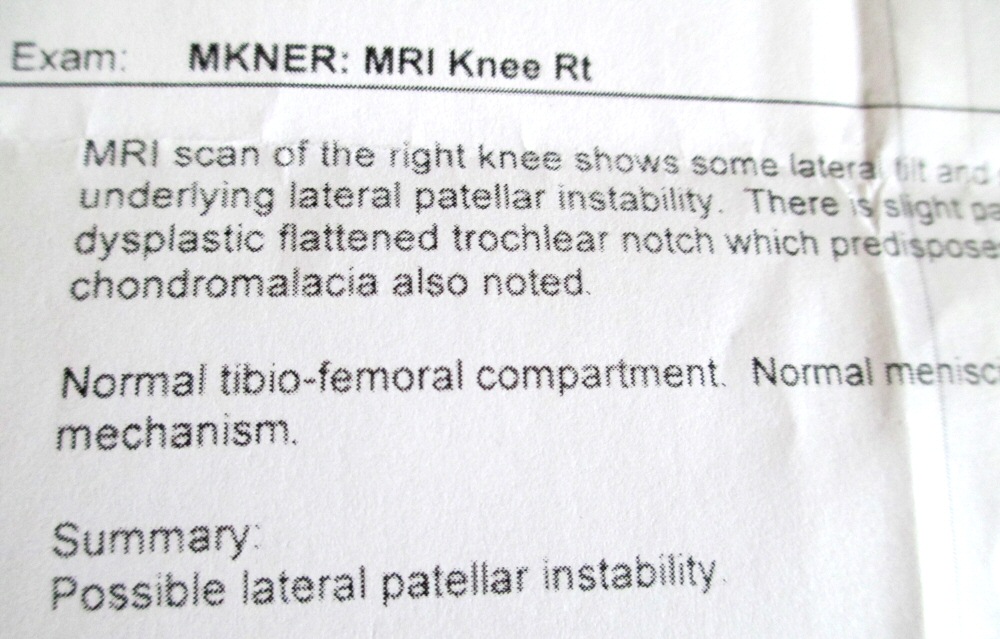
When I phoned the surgery for the test results I was given a vague message, 'Consistent with Ehlers Danlos syndrome.  No further damage'.  I was a bit disappointed.  It didn't really tell me anything and I thought my problems were going to get swept under the carpet and ignored once again.  I made an appointment to speak to my GP about the results and what I found out I have a wobbly knee cap!

After 25 years of problems I finally knew what was wrong.  My patella showed lateral tilt and subluxation which could be due to patellar instability.  I had a slight patella alta, dysplastic flattened trochlear notch and early patellar chondromalacia.

In English that means my knee cap is at a funny angle, it's too high, there is no grove to keep it in place when I bend my knee so it partially dislocates, and the back of my knee cap is worn down more than it should be.

This fits with my diagnosis of Ehlers Danlos Syndrome and explains why I have found it so difficult to walk and exercise.  I don't have a fear of moving or hypersensitivity to pain, I actually have a physical problem.  It's news I didn't want to hear but it is reassuring after so many years of disbelief.

The next big question is what can I do about it?  I have been referred to an orthopaedic surgeon to discuss my options.  In otherwise healthy people they would do surgery to correct the problem but EDS complicates things and could potentially make things worse.  It looks like I have some hard decisions to make but I'm hoping I will be given a few options regarding my potential treatment.  I am frustrated that it has taken this long to find out what is going on but at least now I have a way to move forward.

Friday, 3 July 2015

Sam's Amazing Loom Band Challenge

Words cannot describe how proud I am of my nine year old son, Samuel.  Early this year he came to me and said he wanted to help people with EDS.  He'd had an idea, he loved loom bands and he wanted to make a 500 metre long band in a fundraising challenge for Ehlers Danlos Support UK.

I thought it was a wonderful idea so we support Sam the best we could.  He already had quite a collection of loom bands but we calculated we would need tens of thousands of bands to complete the challenge so we started buying up bulk packs of loom bands on eBay.

Sam worked incredibly hard, every spare moment he tirelessly worked on his project.  Every morning, every afternoon when he came home from school, every evening after tea.  He showed such dedication I knew he would reach his target.

I set up a Just Giving page for him and we put out requests for any unwanted loom bands.  We had an amazing response, including a very generous donation from a boy who had been making loom bands for a local hospice charity.

Despite being quite poorly in April with a chronic cough Sam continued his challenge.  We measured his now giant ball of loom bands on the pavement outside our house and he was almost half way there!

Measuring the loom bands proved another challenge.  I made Samuel a measuring wheel out of cardboard and Kinex and with the help of his friends and my PA we measured the now giant reel of loom bands.  475 metres!  Almost there!

Sam didn't give up.  When his friends came to call he would tell them he was busy finishing his loom bands and I'm very proud to say he reached his target.  All by himself he had made a loom  band over 500 metres long!

Ehlers Danlos Support UK were very kind and sent Sam a certificate to mark his achievement.  Sam wanted to make a video to thank everyone for their support.


Sam's next challenge is to reach is £150 fundraising target.  Can you help?  Please visit our Just Giving page:

www.justgiving.com/SamsChallenge


Tuesday, 5 May 2015

Ehlers Danlos Awareness Month

May is Ehlers Danlos awareness month.  On social media every month seems to be an awareness month for something so why should you be made aware of Ehlers Danlos Syndrome? The simple answer is you need to be aware because most doctors aren't.

If you suffer with joint pain, fatigue and are hypermobile you may have EDS and not even know it.

EDS is a genetic connective tissue condition that is a multi-systemic syndrome.  That means if affects just about every part of your body, you skin, your joints, your muscles, ligaments and tendons, your internal organs and gastrointestinal tract.  Everything!  I causes pain, disability and the vascular type can be fatal.  There is no cure.

EDS is invisible.  You can't see it and it doesn't show up on blood tests so it's very difficult for doctors to diagnose it.  Getting a diagnosis is especially challenging because most doctors do not have current information about it.  I recently spoke to a doctor in Accident and Emergency.  He said he knew all about it, then he quoted information that was inaccurate and at least 10 years out of date.

Doctors are taught about the extreme symptoms, the super stretchy skin, the permanently dislocated joints and the fatal aneurysms of the vascular type.  They are told that EDS is one of those rare diseases that if they ever see a single case in their career, they will never see another one.  It's no wonder they are reluctant to diagnose EDS!

I have hypermobility type, it's the most common type and it's diagnosed by the presence of hypermobility and pain.  Some people are naturally hypermobile and are perfectly healthy but if the hypermobility causes pain and soft tissue injuries then EDS may be diagnosed.

The Beighton Scale is often used to diagnose EDS but it only assesses a few joints and was never meant to be used as a diagnostic tool.  This means that some people are told they don't have it because they don't score enough points.


I am very hypermobile in my ankles and shoulders but as they are on the scale they don't count and I was told I didn't have EDS, but when I was examined by an experienced doctors at The Hypermobility Unit in London I was diagnosed.

EDS also causes many other problems, which makes it difficult for doctors to diagnose us.  How can we have so many things wrong with us?  We must be hypochondriacs!

EDS patients can suffer with dizziness and fainting when we stand which is caused by Postural Orthostatic Tachycardia syndrome.  EDS patients suffer with chronic pain from partial dislocations, bursitis and muscle spasms, we injure ourselves easily, we might be clumsy and we bruise easily too.  Some patients suffer slow gastric transit, nausea, constipation and even gastrointestinal failure.  Basically think of a body part, if there is collagen in it then EDS can affect it.

There are several other kinds of EDS, including classical type which causes skin problems and the vascular type which sadly can be life limiting.  It can affect people in different ways at different times. One day you may see an EDS patient in a wheelchair, the next day they can be walking.  They aren't faking it or doing it for the attention, they are struggling with a complex condition and doing the best they can.

So why should you be aware of EDS?  Because more research needs to be done to help people with this complex and incurable condition and it's not as rare as doctors might think.  For a start, it's genetic and there is a 50% chance the children of an EDS patient will also have EDS.

Perhaps you know someone with ME, CFS or Fibromyalgia who is hypermobile and fits the EDS profile?  Being aware of EDS can mean getting the right diagnosis and that might just change their life.

If you want to know more about EDS visit the Ehlers Danlos Support UK website.


Sunday, 19 April 2015

No two zebras are alike

If there's one thing that I've learned from my Ehlers Danlos journey is that no two zebras are alike.  We all different, sometimes VERY different.  So that led me to question why is the advice always the same? We might have the same genetic cause for our symptoms, defective collagen, but how that affects us can range from having joints so loose they are permanently hanging out of their sockets, to muscles working so hard to keep joints in place that they are permanently in spasm.  There are people who can live a relatively normal life and others who suffer life limiting complications.  There is no one size fits all solution, so why do medics always give the same standard advice?

I don't envy the doctors dealing with us zebras.  We have so many complex problems that it's difficult to know where to start, so most don't want to get involved.  Even consultants discharge us back to our GPs because they don't know how to deal with us.

I went to Stanmore's rehabilitation course hoping for some understanding but what I found what the same generalised advice that didn't really fit my experiences or capabilities.  I didn't really learn very much apart from that I'm much sicker than I thought I was.  I thought I could manage and I did manage to a certain extent but by the time I'd got up, washed, been to the restaurant for breakfast and made it to stretch class I was done in, and the day hadn't even started.  And the staff wanted me to do MORE!  I gave it my best shot, buoyed by stories of people arriving in a wheelchair and walking out three weeks later practically cured, but the opposite happen to me.

Pacing will allow you to do more, they said.  A social care package is not the answer to all your problems.  If you can't do all the ironing in one go then iron one shirt at a time.  This would be good advice if getting the ironing board out didn't cause me so much pain that I wouldn't be able to iron a shirt.  They didn't consider how a social care package actually allowed me to pace.

When you're having a flare up don't stay in bed all day, get up, do your physio, pace your activities. For me a flare up is when I can't get out of bed!  The alternative to staying in bed is face planting on the bedroom floor because I haven't got the strength or the energy to walk to the bathroom.

Do pilates, it's good for you.  Done that, made me worse.  It was really cool but holding pilates poses when you have muscle spasms makes you have more muscle spasms.  After three one to one sessions I was in severe pain for three months.  Not exactly a solution.  What about tai chi?  For someone with POTS who can't stand without walking aids?  It's something I've always wanted to try but my shoulder is so unstable it goes clunk just drinking a cup of tea.

If you think physio is going to make you worse then that's called catastrophising, according to the rehab handbook.  It's negative thinking that you need to change.  Really?  So if you think that hitting your thumb with a hammer is going to hurt you need to change your negative thinking?  Will that stop it hurting?  Hmm, perhaps it doesn't always work like that.

Chronic pain is not caused by physical injury. Any injury will have healed after a few weeks so it's down to faulty pain signals or an illusion because you're overreacting to those signals, like the Lorimer Moseley video.  So when I sprain my ankle and it still hurts three months later is it because of 'chronic pain', my nerves sending out the wrong signals that the brain interprets as pain, or is it because my ligaments are too loose and I spray my ankle almost every day so it never actually healed?  To me that makes a whole lot more sense because I don't overreact to pain and I'm not afraid to move because of the pain.  Doing stuff just makes me hurt more. I need to find a way of moving that doesn't hurt instead of being told it's all in my head.

I told the Stanmore team that being in a swimming pool triggered severe symptoms but it was mandatory to have a pool session.  I love the water and I trusted the staff so I went in the pool, I spent a few minutes in the water and it triggered a severe flare of symptoms.  I was frustrated that I had to make myself ill to make them believe what I said was true and not just 'negative thinking'.  I was even more frustrated when the flare up became so severe that I had to leave the course half way through.  I felt like I had failed but on reflection it was the team who had failed me.

I have EDS, I know these things help some people with EDS but unfortunately they don't help me.  I need something different but there isn't anything different.

Something has to change.

I have tried to do things their way but I didn't fit their solutions so now it's up to me to find solutions that fit me.  I know I'm not the only one, like I said, we're all different but it would be good if the medics started to listen to the patients rather than just handing out standard advice due to the name of their condition.  Research needs to be done into why we feel pain so we can learn what to do about it rather than just expecting everyone to do physiol, take painkillers and learn to live with it.

Monday, 13 April 2015

Sam's Challenge

I am very proud of my nine year old son, Samuel. He wanted to raise money for Ehlers Danlos Support UK  so he could help other people like me with EDS.

Samuel loves loom bands and he has challenged himself to make a giant loom band 500 meters long!

I set up a Just Giving page for him and he's already on his way to meeting his target of £150.  He's been working very hard on his loom bands and has already made a band 80 metres long.


If you would like to support Sam's challenge please visit: 


Sam will need around 75,000 looms bands to complete his challenge.  If you would like to donate any unwanted loom bands please email clair@dunmani.co.uk

Thank you for your support!


Tuesday, 31 March 2015

An open letter to David Cameron

In the lead up to the general election I've been thinking about who I should vote for.  The leaked Conservative party benefit options got me very worried because it could mean financial hardship for my family simply because I am too ill to work.

I understand the need to make budget cuts but penalising the chronically ill and the disabled is unfair and a false economy.  I got quite angry about it so to vent my frustrations I decided to write an open letter to David Cameron.

-----------------------------------------------------------------

Dear David Cameron

I wonder if I could ask you a question.  Why should I vote for you?
 
My name is Clair Coult, I am married with three children, my husband works full time but I am unable to work due to being chronically ill and disabled.  I suffer with a rare and incurable genetic condition called Ehlers Danlos Syndrome - Hypermobility Type, I also have a condition called Postural Orthostatic Tachycardia Syndrome and an autoimmune condition called Sjogren's Syndrome.  Every day I suffer with severe joint pain, fatigue, tachycardia and a whole host of debilitating symptoms.  I am virtually unable to walk but with the right medical, social and financial support I can manage my symptoms, have a better quality of  life and I can contribute to our society in my own small way.

The problem is it is very difficult to get the support I need.  The NHS has repeatedly failed me.  I was misdiagnosed and mistreated for 24 years.  I had to research my own health problems and pay privately to get the correct diagnosis.  I have also struggled to get any support in managing my condition on the NHS. 

In 2013 I was discharged from A&E in severe pain and considerable distress.  I was told to discuss my problems with my consultant.  The waiting time to see my consultant was 22 weeks.  I could not get an earlier appointment.  I paid to see a private consultant and I was seen within 11 days.  It cost £300 and I was given treatment that managed my severe pain. 

My consultant said I need extensive physio but NHS policy means I can only get 6 weeks treatment on one body part, then I have to wait another 8 weeks to be referred again.  This is crazy! 

When my consultant writes to my GP it can takes weeks, sometimes months before the letter is processed and anything is done about it.  This causes an unnecessary delay in my treatment and prolongs my suffering.  This is not acceptable.

My GP is under pressure to reduce referral costs so she is reluctant to refer me to people who can help me manage my conditions and give me a better quality of life.  This means I either go without support or I have to pay privately for consultations and treatment.  This is not acceptable.

I have to pay for my own prescriptions, annual sight tests (essential due to the risks of my medication) and dental treatments.  I purchase a pre-payment prescription certificate but it costs me £104 a year and I still have to pay for my necessary vitamins, supplements, compression stockings and treatments.  My dental treatment costs are high due to the damage that Sjogren's syndrome does to my mouth.  Dental bills often cost several hundred pounds per year.
 
I also have to pay for disability aids and equipment.  I have an NHS manual wheelchair but I cannot push it myself so I have had to pay £600 for a mobility scooter and £500 for a second hand electric wheelchair for the privilege of moving around independently.  I also have NHS crutches but by using them I risk damaging my unstable joints so I have had to pay £90 for a more suitable pair of crutches. 

I have been assessed as needing a stair lift but because my husband is in full time employment we would have to pay £9,000 for one.  I was loaned a bath lift by Occupational Therapy, essential for my safety when bathing, but it did not meet my needs.  The most suitable bath lift would cost me £600.  We cannot afford to pay for either a stair lift or a bath lift without getting into debt of nearly £10,000.  I could use my DLA lower rate care money but it would take me over 8 years to save up.  This is not acceptable.

I need support to manage my personal, social and domestic care needs but cuts to the local authority budget mean they cannot afford to meet my eligible needs as outlined in Fair Access To Care Services.  My revised care plan was very limited and basically treated me like a prisoner.  I was only allowed to leave the house for 2 hours a week, I could only do supermarket shopping on the internet, not at the local shops or market, and I was only allowed three hours support a week with all domestic chores (cleaning, shopping and laundry) for a family of five.  They expected my husband to work full time, commute 50 minutes each way to work, do all the household chores, laundry and shopping, and also be a full time carer for me and our three children.  That is an impossible task for one person. 

I have been lied to and bullied by social workers and last year it took seven months of fighting with my local authority for me to retain my care package.  I had to seek the help of my MP, research policy documents and put in a Freedom Of Information request regarding a policy that was quoted by several social workers but the policy never actually existed.  The assessments were not about supporting me to live independently and meeting my eligible needs, they were about reducing my care package and cutting costs as much as possible.  The stress and effort involved caused my health problems to significantly deteriorate.  This is not acceptable.

I claim Employment Support Allowance and due to the severity of my disabilities I have been placed in the Support Group, but I am concerned that in the future I will be unable to claim because my husband works full time.  Due to the high costs involved in managing my disabilities the loss of ESA would leave my family in financial difficulty.  This is not acceptable.

I currently claim DLA but I am also concerned about being migrated to PIP as the assessment does not take into consideration the complex and variable nature of my health problems.  I have already had to give up my Motability car because I didn't know if I would qualify for PIP and we couldn't afford to be without a suitable vehicle.  Ehlers Danlos Syndrome is a variable and often misunderstood condition.  Sometimes I can just about walk 20 metres, sometimes I can't even stand up.  How far I can walk cannot be answered by a tick box because every hour of every day is different. 

Ehlers Danlos Syndrome is also rare and I have to travel 150 miles to London to see my consultants as local doctors do not have the experience or knowledge to help me.  This can cost up to £200 in train tickets alone, plus my husband has to take unpaid leave from work to take me as I am unable to travel on my own.  If you take away my mobility support I will be unable to attend the essential medical appointments that help me manage my conditions.  This is not acceptable. 

I understand that in this economy cuts have to be made but cutting NHS, social care and disability benefits is false economy.  You are punishing the people who cannot help themselves, through no fault of their own. 

If you deny me access to adequate medical and social care my health will deteriorate to the point where I will need 24 hour nursing care.  This will cost the government significantly more than supporting me to live independently with my family.

I am not alone in this situation.  There are thousands of chronically ill and disabled people like me struggling for help and support, and I think I can speak for them when I say our lives are challenging enough as it is without having to fight for the support we need to do the things you take for granted.

So considering my situation, could you please tell me why should I vote for you? 

Are you going to do anything to support chronically ill and disabled people like me? 

Yours sincerely

Clair Coult